


My Talking Tom Friends
Outfit7 Limited
My Talking Tom Friends works best when you treat it as a small, playful routine rather than a traditional game with a clear finish line. I spent time moving between its friendly characters, looking after their needs, creating little scenes and dipping into the mini-games, and the appeal became clear: it gives younger players an easy space for imaginative play without demanding complicated controls or a long tutorial.
That simplicity is also the reason I would not recommend it to everyone. Players looking for deep progression, demanding challenges or a story with a strong ending may find the experience repetitive. For families, casual players and anyone who enjoys virtual pets, however, this is a cheerful time-filler with a surprisingly useful strength: it turns short visits into small stories instead of asking you to commit to a long session.
How the shared home and mini-games shape the experience
The central idea is caring for Tom and his friends together. Rather than focusing on one character in isolation, I move around a shared setting and respond to what the group needs. That gives the game a more social feeling than a basic virtual-pet app. The characters become a little cast, and even a simple action can become part of a made-up scene.
I found this especially effective for children who like role-play. One visit can become a morning routine, a pretend party or a quick story about everyone taking turns. The game does not need elaborate writing to support that kind of play. The player supplies the imagination, while the characters, activities and mini-games provide the prompts.
The controls are approachable, which is important for its Everyone age rating. A child who is comfortable tapping, dragging and choosing activities can begin without having to understand a complicated interface. I would still play alongside a younger child at first, not because the basic idea is difficult, but because shared play makes it easier to understand what each activity is for and how the game’s rewards or purchases fit into the experience.
Related News

Why WhatsApp Messenger Still Makes Everyday Communication Feel Easy

Jurassic World: The Game Is the Better Dino Tycoon for Strategic Players

Threads in Real Life: Who Should Join, Lurk, or Leave

How SHEIN Turned Shopping Into an Endless Content Feed

How to Make Fortnite Feel Smarter on Mobile

Should You Switch to Microsoft Outlook on Mobile?
The mini-games are a useful change of pace. Caring for characters can become predictable when repeated, so switching to a quick challenge helps keep a session lively. I liked using them as a reset: after spending time with the characters, a short game adds an active moment before returning to the home area. This rhythm is more suitable for casual play than a single activity that expects constant attention.
One practical tip is to avoid treating every visit as a checklist. I got more enjoyment by choosing one small theme for a session, such as making the characters interact or trying a mini-game before leaving. That approach prevents the routine from feeling like maintenance. It also makes the game more suitable for brief breaks, because I can finish with a sense that something happened even without completing a large objective.
Why the character group matters more than it first appears
The group format gives the game its strongest personality. A single virtual pet can feel like a responsibility simulator, while several familiar characters create more opportunities for pretend conversations and improvised situations. I could imagine one character being the energetic one, another being left out, and another taking the lead, even when the game itself leaves much of that interpretation to me.
Gallery
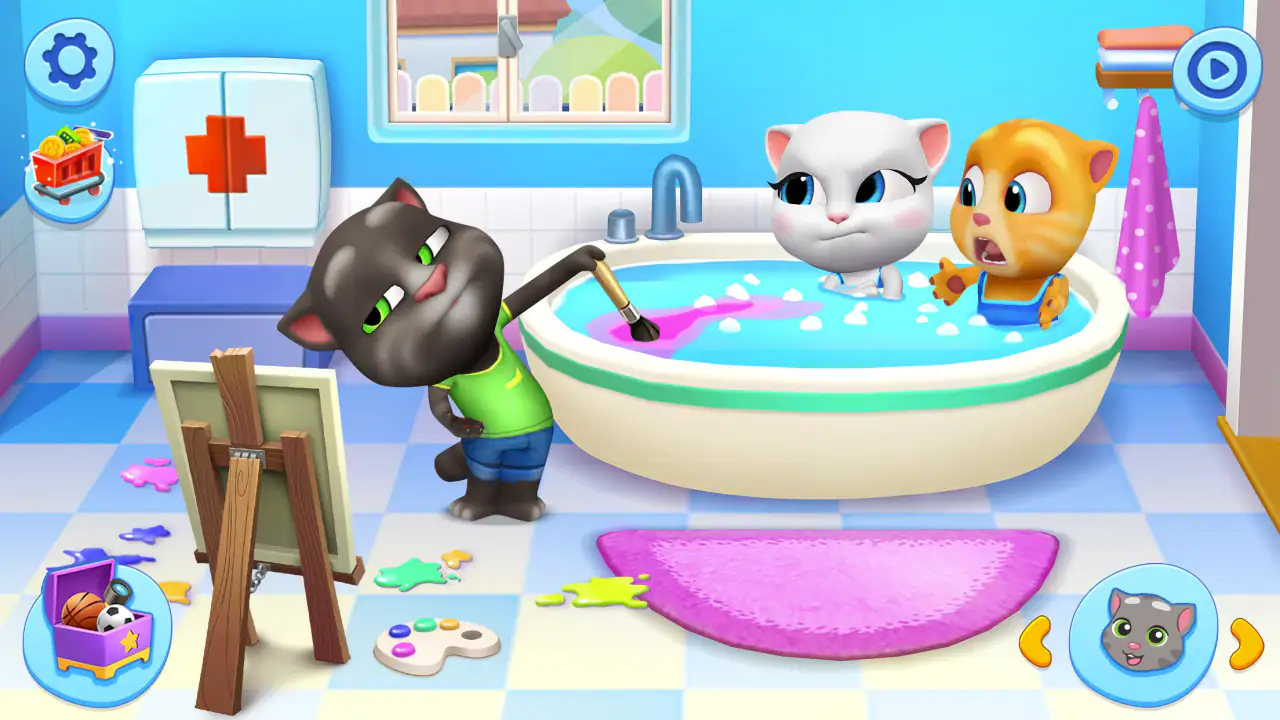
This is a good fit for children who enjoy arranging scenes and repeating favorite actions. It also works for adults who want a light game that can be opened for a few minutes without remembering a complex plot. The tone stays gentle, and the focus remains on interaction rather than competition.
There is a subtle trade-off here. More characters mean more variety, but they can also make the experience feel busier. A player who prefers a quiet, focused virtual-pet routine may find the shared environment less calming than an app built around one pet. I see that as a matter of taste rather than a flaw, but it is worth considering before downloading.
What I would do during an ordinary day
In an everyday scenario, I would use this game during a short waiting period or as a relaxed activity after school. I might open it, check what Tom and the others are doing, choose one interaction, then play a mini-game before putting the phone away. That is enough to make the session feel complete. It does not require the player to remember a complicated set of objectives or reserve an entire evening.
For a parent, the same structure can support shared play. A child can decide what story the characters are acting out, while an adult helps with navigation and talks about the choices being made. The game becomes more than silent screen time when the characters are used as prompts for conversation. I would not present it as an educational tool, though; its value is mainly creative play, routine and entertainment.
Another useful habit is to let the child choose the pace. If the player wants to focus on mini-games, there is no need to force a long caring routine first. If the player prefers storytelling, the activities can be treated as props for an imagined scene. This flexibility is one of the reasons the game feels more inviting than a rigid level-based casual title.
Where it stands beside other casual choices
Compared with a conventional puzzle game, this is less about mastering a system and more about returning to a familiar group of characters. A puzzle title may offer clearer goals and a stronger sense of improvement, while this game offers more freedom to invent small moments. If I want a quick challenge that tests concentration, I would choose a dedicated puzzle game. If I want a soft, character-led activity, this is the better match.
Compared with a single-pet app, the shared cast gives it more variety in the way a session can unfold. The cost is that the experience may feel less focused. A single-pet alternative can be preferable for someone who wants a simple one-to-one routine with minimal distraction.
Compared with a story-driven adventure, this game is much lighter. There is no reason to approach it expecting dramatic progression or carefully paced narrative development. Its stories are the ones the player creates through interactions. That makes it accessible, but it also means that players who want a plot to pull them forward may lose interest sooner.
Its large audience reflects how approachable the concept is: the game has passed 500 million installs and holds a 4.3 average from around 4 million ratings. Those figures do not change my personal experience, but they do fit the game’s broad appeal. It is easy to understand, visually inviting and built around a recognizable style from Outfit7 Limited.
The friction I noticed after the initial charm
The main weakness is repetition. The first sessions benefit from discovering the characters and seeing how the activities fit together. After that, the same basic loop can feel familiar quickly, especially for players who want constant novelty. The mini-games help, but they do not completely change the underlying rhythm of caring, interacting and returning later.
I also think the game can encourage longer sessions than intended because there is always another character or activity to check. That is not unusual for a casual game, but families should decide their own screen-time boundaries rather than relying on the game to create them. Short, planned visits work better for me than leaving it open as an all-day background activity.
In-app purchases are another point to consider. The game is free to download, but individual purchases range from $0.99 to $99.99. I would review purchase settings before handing the device to a child and make sure everyone understands that free access does not mean every optional item is free. This is one of the most important practical steps for parents, because the playful presentation can make spending feel like part of the game rather than a separate decision.
The free entry is still a meaningful advantage. I could test the basic loop before deciding whether it deserved a regular place on my device. That is better than committing immediately to a paid casual game, particularly when I am unsure whether virtual-pet routines will hold my attention. The trade-off is that the presence of optional purchases can affect how comfortable some families feel using it.
Device compatibility is reasonably broad, with the current version listed as 26.1.1.18074 and support beginning with Android 6.0. I would still check the available store page on the intended device before installing, especially on an older phone or tablet. The version detail matters because casual games can change over time, and using the current build is the simplest way to avoid judging an outdated experience.
Who will enjoy it most
I would recommend it first to children who like familiar characters, pretend play and short activities. It is also a good choice for families looking for something they can explore together without teaching complex rules. The Everyone rating supports its broad accessibility, although age labels do not replace adult guidance around purchases or screen time.
It suits casual players who enjoy checking in regularly rather than chasing a final victory. Someone who likes decorating a personal routine with small interactions may find plenty to enjoy. The game is also a reasonable option for a child who becomes frustrated by difficult controls, because the basic concept is much easier to approach than a demanding action or strategy title.
I would be more cautious about recommending it to older players who need deep challenge. If your ideal game involves carefully balanced levels, competitive rankings or a long campaign, this will probably feel too light. The same applies if you dislike virtual-pet mechanics in general. Caring for characters is not a side feature here; it is the foundation of the experience.
It may also be the wrong choice for someone seeking a completely offline-feeling, distraction-free toy. The free-to-play structure and purchase options mean that adults may want to supervise how the game is used. For a child’s first independent game, I would introduce it with clear boundaries and perhaps play the opening sessions together.
Small techniques that make the loop more enjoyable
My first recommendation is to use the mini-games as punctuation, not as the entire purpose of a visit. Starting with one character interaction and then changing activities keeps the session from becoming mechanical. If a child only repeats the fastest available action, the broader appeal of the group can disappear.
My second tip is to create simple story prompts. Decide that the characters are preparing for a trip, solving a small disagreement or welcoming someone into the group, then use the available interactions to act it out. This makes the experience feel more personal and gives children a reason to revisit familiar activities without expecting new content every time.
Third, I would separate “wanting to play” from “wanting to buy.” A child may ask for an item because it appears during a fun moment, not because they understand its value. Setting a rule before play begins makes the decision easier and avoids turning every session into a negotiation. This is particularly important when optional purchases can reach a high amount for a single item.
Finally, I would keep expectations modest. The game is strongest as a gentle companion for short creative sessions, not as a replacement for a full adventure or a challenging arcade title. Knowing that in advance makes its repetition easier to accept and helps the right audience enjoy what it actually offers.
My final recommendation
After spending time with it, I see My Talking Tom Friends as a polished casual game built around warmth, accessibility and player-made stories. Its best feature is not one particular mini-game; it is the way several familiar characters turn ordinary interactions into a shared little world. That makes it easy to recommend to children and families who enjoy imaginative play.
The limitations are equally clear. The routine can become repetitive, the challenge is intentionally light and the purchase range deserves adult attention. Players who want a strong narrative, demanding progression or a focused one-pet experience may be happier elsewhere.
For me, the deciding question is simple: do you want a game to beat, or a group of characters to visit? If you want the second option, this free casual title is worth trying. Outfit7 Limited has made something approachable enough for quick visits and flexible enough for children to shape their own stories. I would install it for relaxed family play, keep spending controls in place and judge it by the small moments it creates rather than by how long it keeps me playing.
It was released on June 11, 2020, and remains an accessible choice for players using Android 6.0 or later. With an Everyone age rating and over 25 thousand reviews, it has the kind of broad, low-pressure appeal that makes it easy to share. My verdict is positive but specific: choose it for character-led creativity and gentle routines, skip it if you need depth, competition or a clear ending.
FAQs for My Talking Tom Friends
What is My Talking Tom Friends?
My Talking Tom Friends is a virtual pet simulation game where players can interact with a group of characters, including Tom and his friends. Players can feed them, dress them up, and engage in mini-games. The game combines elements of care-taking, customization, and social interaction, making it appealing to a wide audience.
Is My Talking Tom Friends free to play?
Yes, My Talking Tom Friends is free to download and play. However, it offers in-app purchases for various items and features, such as new outfits and faster progression. While the game can be enjoyed without spending money, purchasing these items can enhance the experience.
What age group is My Talking Tom Friends suitable for?
My Talking Tom Friends is designed for players of all ages, but it is particularly popular among children. The game features colorful graphics, simple controls, and engaging activities that appeal to younger audiences. Parents should be aware of in-app purchases and supervise the gameplay to ensure a safe experience.
How does the game support player interaction?
The game encourages interaction by allowing players to engage with multiple characters simultaneously. Players can feed, bathe, and play with each character, fostering a sense of companionship. Additionally, the game includes mini-games and challenges that help keep players entertained and engaged over time.
Does My Talking Tom Friends require an internet connection?
My Talking Tom Friends can be played offline, but certain features may require an internet connection. For example, downloading updates, accessing certain in-game items, and participating in specific events might need connectivity. Playing offline limits some interactive and social features, but the core gameplay remains accessible.
Pros
- Engaging gameplay for all ages.
- Customizable character features.
- Regular updates with new content.
- Interactive and educational mini-games.
- User-friendly interface and controls.
Cons
- Contains in-app purchases.
- Requires constant internet connection.
- Advertisements can be intrusive.
- Limited offline functionality.
- Can be repetitive over time.


